Generating gravitational wave spectra from equations of state for phase transitions in the early universe
Mika Mäki, Doctoral Researcher,
Computational Field Theory group, University of Helsinki
Physics Days
6.3.2026
In collaboration with David Weir, Mark Hindmarsh, Deanna Hooper & Lorenzo Giombi
Phase transitions in the early universe
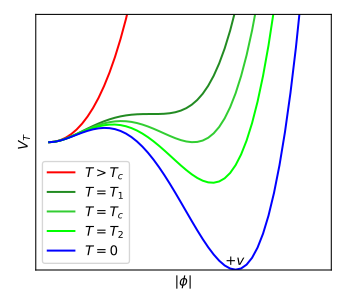
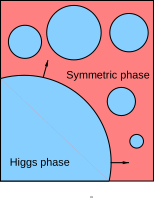
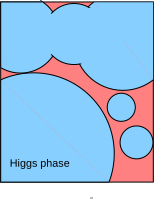
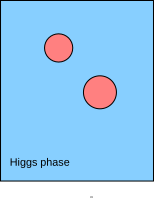
- First-order: potential barrier
⇒ phase boundary ⇒ bubble nucleation - SM Higgs: crossover, BSM Higgs: first-order
⇒ Experimental testing of BSM theories
Different types of phase transition simulations
- Lattice simulations
- Capture multiple types of effects: bubble expansion, collision and turbulence
- Computationally expensive
- Analytical approximations
- Broken power law, double broken power law
- Useful but rather crude approximations
- Semi-analytical approximation: Sound Shell Model
- Captures dependence on phase transition parameters
- Reproduces the results of lattice simulations for intermediate-strength transitions
- This is what we are working on
Self-similar fluid shells
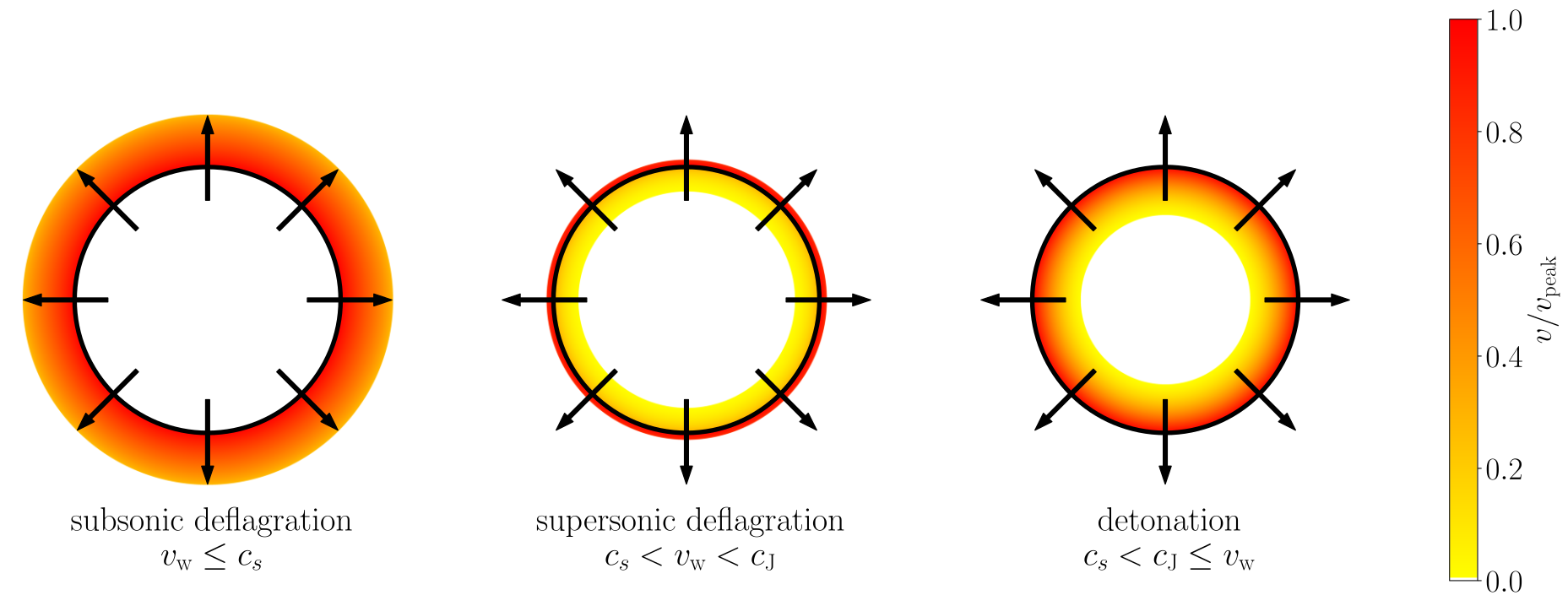
Source:
Hindmarsh et al. (2021,
arXiv:2008.09136),
hybrids discovered by Kurki-Suonio & Laine (1995,
arXiv:hep-ph/9501216)
Friction → constant $v_\text{wall}$ → self-similar solution
Three types of solutions, determined by
Three types of solutions, determined by
- Wall velocity $v_\text{wall}$
- Transition strength $\alpha_n$
- Speed of sound $c_s(T,\phi)$
Explanation of the figure
- Black circle: phase boundary, aka. bubble wall
- Colour: velocity of moving plasma
- $c_s$: speed of sound
- $v_\text{w}$: wall speed
- $c_\text{J}$: Chapman-Jouguet speed
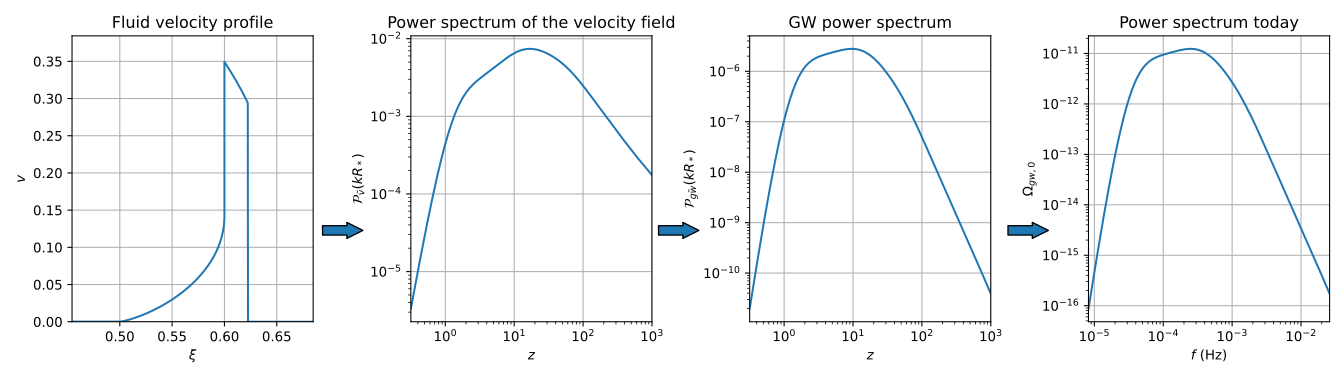
From fluid profiles to GW spectra
🠮
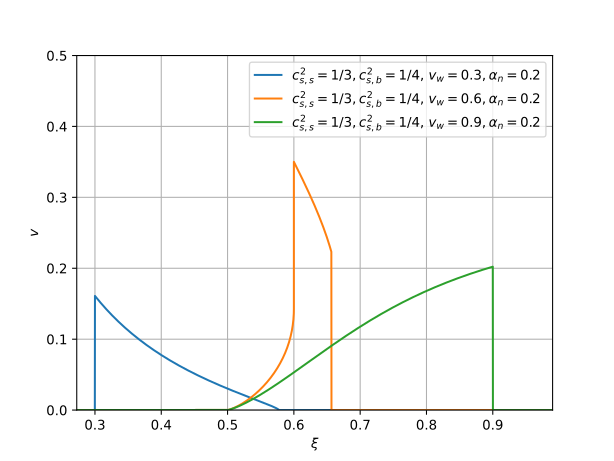
Fluid shell velocity profiles
- Boundary conditions
- ODE integration
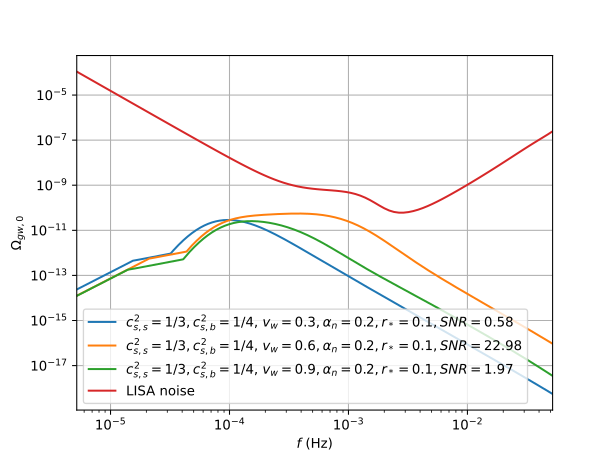
GW spectra
- Sound Shell Model: sine transform etc.
- Conversion to observable $f$ etc.
- Experimentally testable by LISA
PTtools & PTPlot
-
PTtools
- Simulation framework (Python library), doi:10.5281/zenodo.15268219
- Based on the Sound Shell Model by Hindmarsh et al.
- Developed by Mark Hindmarsh, Chloe Hopling (f.k.a. Gowling), Mika Mäki & Lorenzo Giombi
-
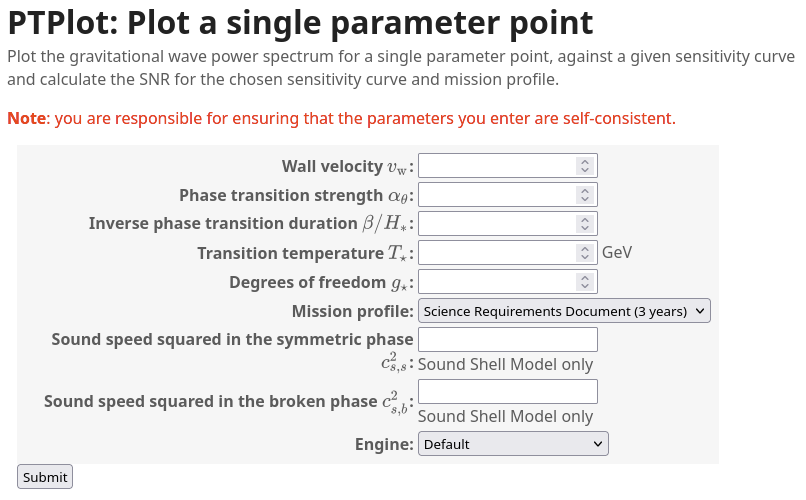
PTPlot
- Online plotting utility (Django web app), arXiv:1704.05871
- Developed by David Weir, Deanna Hooper, Jenni Häkkinen & Mika Mäki
-
Supports several models for the GW spectrum
- Broken power law
- Double broken power law (in development)
- Sound Shell Model (in development)
-
Input
- Equation of state: $p(T,\phi) = \frac{\pi^2}{90} g_p(T,\phi) T^4 - V(T,\phi)$
- Wall speed $v_\text{wall}$
- Transition strength parameter $\alpha_n \equiv \frac{4D\theta(T_n)}{3w_n} = \frac{4}{3} \frac{\theta_+(T_n) - \theta_-(T_n)}{w_n}$
- Hubble-scaled mean bubble spacing $r_* \equiv H_n R_*$
-
Output:
- GW power spectrum today $\Omega_{gw,0}(f)$
- Signal-to-noise ratio (SNR) plots
- Use case: estimate the likelihood of various Standard Model extensions with LISA data
Signal-to-noise ratio (SNR) with different simulation models
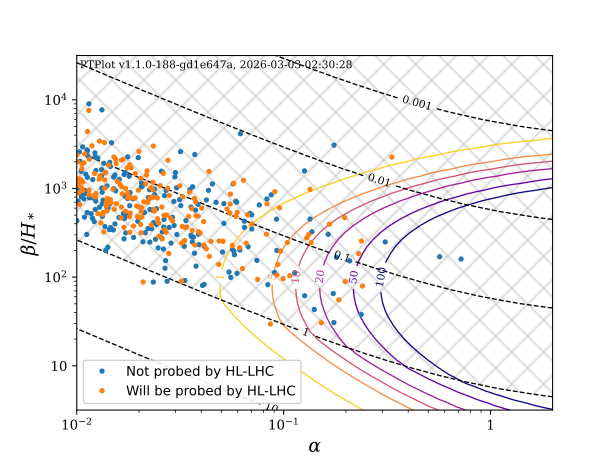 Broken power law (BPL)
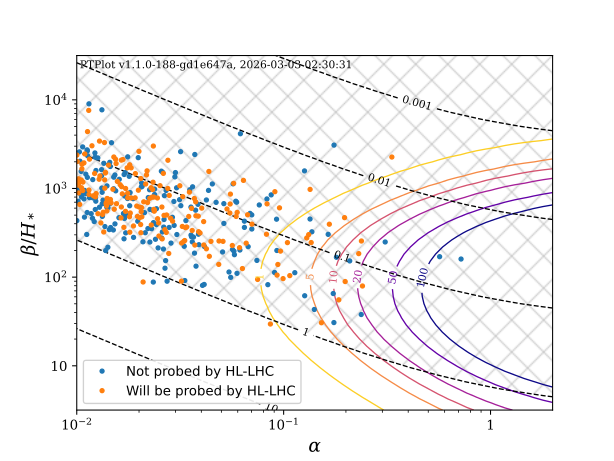 Double broken power law (DBPL)
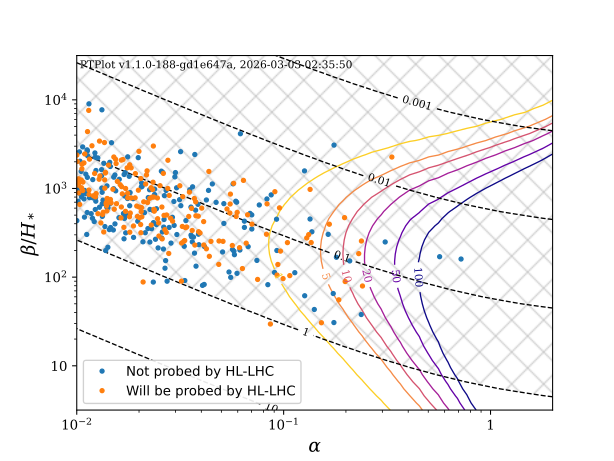 Sound Shell Model (SSM)
-
Example particle physics model: Singlet scalar
-
SM extended with a general real singlet scalar field $S$
$$ \Delta V = b_1 S + \frac{1}{2} b_2 S^2 + \frac{1}{2} a_1 S \left| H \right|^2 + \frac{1}{2} a_2 S^2 \left| H \right|^2 + \frac{1}{3} b_3 S^3 + \frac{1}{4} b_4 S^4 $$ - SNR curves plotted with $v_\text{wall} = 0.95, T_* = 50.0 \ \text{GeV}, g_* = 107.75$
- Example points sampled from the parameter space of the model
-
SM extended with a general real singlet scalar field $S$
- Significant change in the shape of the SNR curves with improved simulations
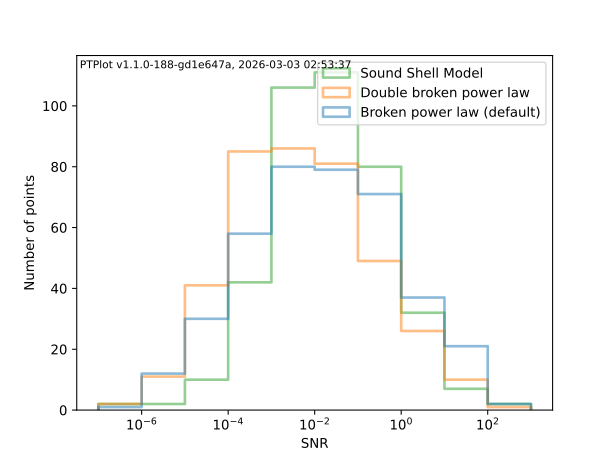
Summary
-
GW spectrum is an experimentally testable result of many BSM theories
- Will be tested by the Laser Interferometer Space Antenna (LISA) in the 2030s
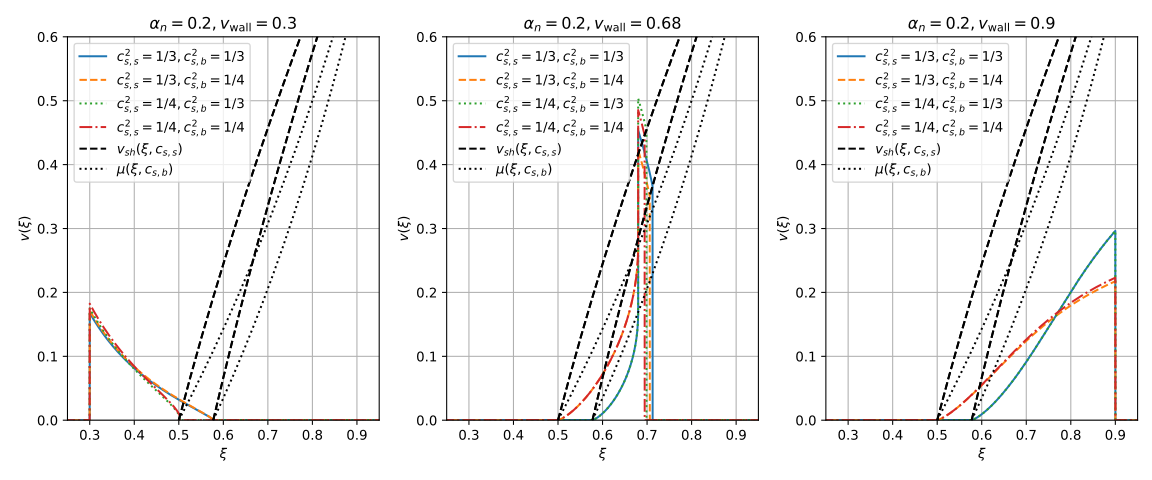
- The equation of state has a significant effect on the sound speed and therefore on the GW spectrum
- Sound Shell Model improves the power spectrum and SNR accuracy compared to broken power laws, while maintaining computational efficiency
-
Utilities:
- PTtools: https://pttools.readthedocs.io
- PTPlot: https://www.ptplot.org
Thank you!
Fluid velocity profiles
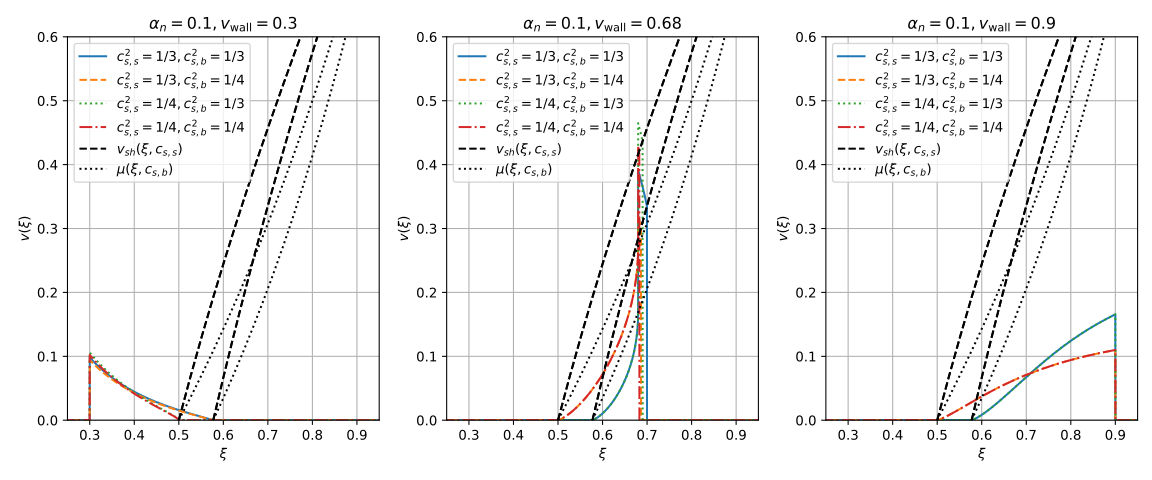
Fluid velocity profiles
GW power spectra
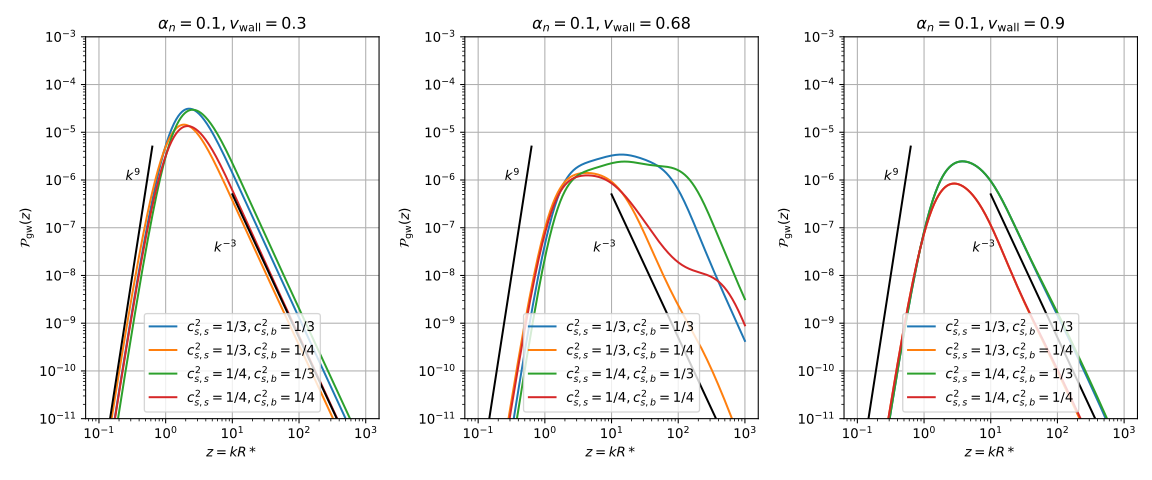
GW power spectra
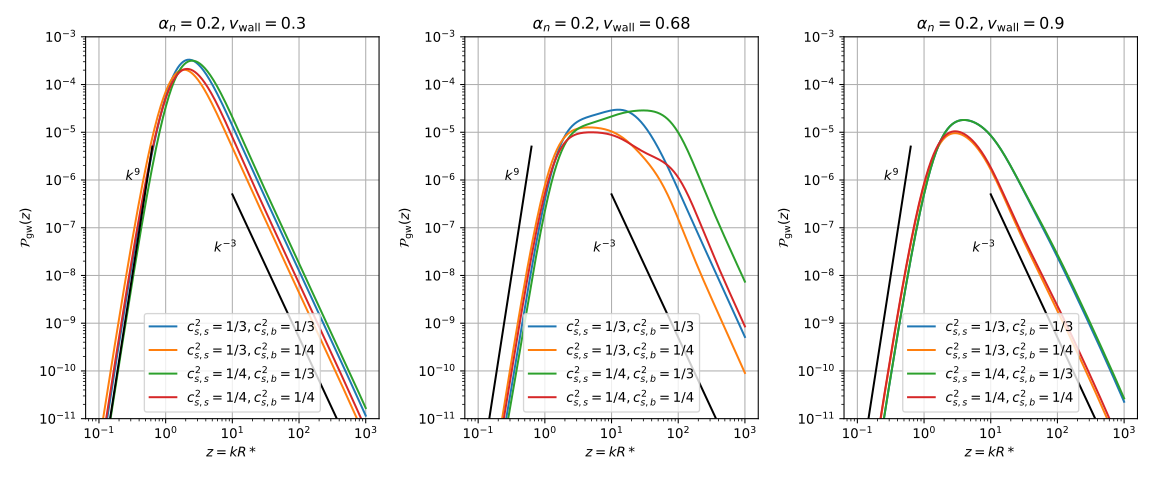
GW power spectra today
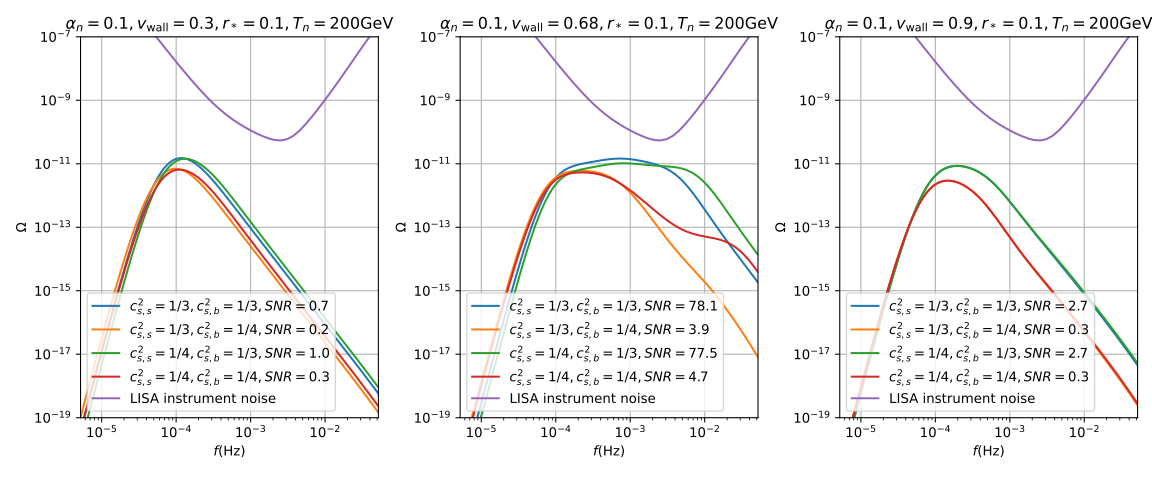
GW power spectra today
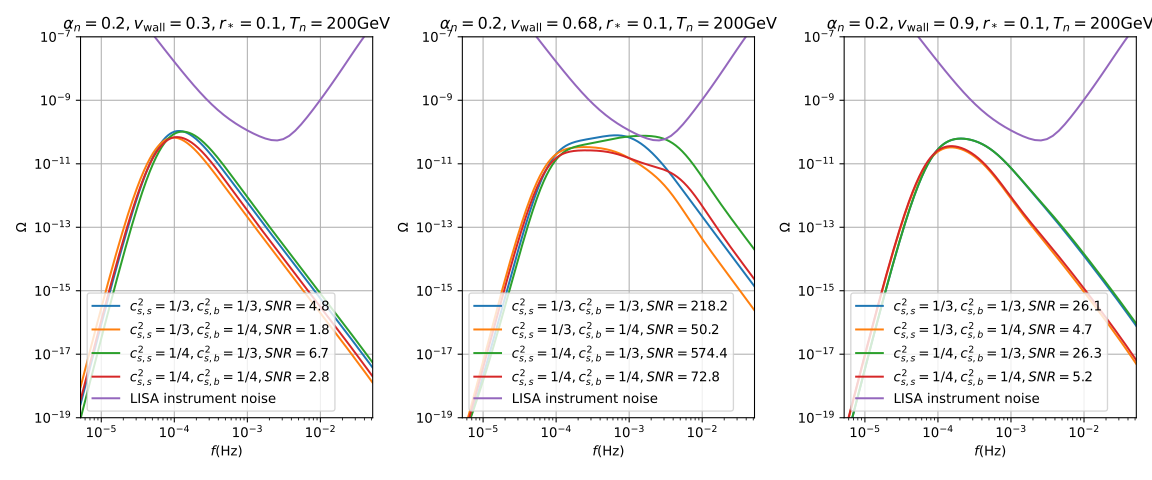
Equations of state
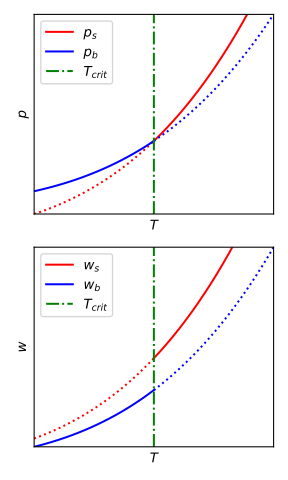
- Equation of state for an ultrarelativistic plasma with multiple degrees of freedom $$p(T,\phi) = \frac{\pi^2}{90} g_p(T,\phi) T^4 - V(T,\phi)$$
-
The rest can be deduced with thermodynamics
-
Entropy density $s = \frac{dp}{dT}$,
enthalpy density $w = Ts$,
energy density $e = w - p$, sound speed $c_s \equiv \sqrt{\frac{dp}{de}}$
-
Entropy density $s = \frac{dp}{dT}$,
enthalpy density $w = Ts$,
- Bag model: equation of state with constant degrees of freedom $$p_\pm = a_\pm T^4 - V_\pm \quad \Rightarrow \quad c_s^2 \equiv \frac{dp}{de} = \frac{1}{3}$$
-
Constant sound speed model
(aka. $\mu, \nu$ model or template model, arXiv:2004.06995, arXiv:2010.09744) $$p_\pm = a_\pm \left( \frac{T}{T_0} \right)^{\mu_\pm - 4} T^4 - V_\pm {\color{gray} \approx a_\pm T^{\mu_\pm} - V_\pm } \quad \Rightarrow \quad c_{s\pm}^2 = \frac{1}{\mu_\pm - 1}$$ -
From an arbitrary particle physics model: $g_p(T,\phi), \ V(T,\phi)$
- This can also be done with e.g. WallGo (arXiv:2411.04970)
Sound Shell Model
- Hindmarsh (2018, arXiv:1608.04735), Hindmarsh & Hijazi (2019, arXiv: 1909.10040)
-
When the transition strength $\alpha_n \ll 1$ and $v_\text{wall} < 1$
- Sound waves are the majority contribution
→ collisions and turbulence can be neglected → no interaction between the bubbles
- Sound waves are the majority contribution
Correction factors
-
Giombi et al. (2024):
Changing the sound speed → source lifetime factor $\Lambda$
$$\begin{align} \tilde{P}_\text{gw,corr.}(k) &\equiv \Lambda \tilde{P}_\text{gw}(k) & \Lambda &\equiv \frac{1}{1 + 2\nu} \left(1 - \left(1 + \frac{\Delta \eta}{\eta_*} \right) \right)^{-1-2\nu} \\ \nu_\text{gdh2024} &\equiv \frac{1-3\omega}{1 + 3\omega} & \omega(T,\phi) &\equiv \frac{p(T,\phi)}{e(T,\phi)} \quad \textcolor{gray}{\omega_\text{bag} = \frac{1}{3} \rightarrow \nu_\text{bag} = 0} \end{align}$$ -
Gowling & Hindmarsh (2021): Suppression factor
- From comparison with 3D hydrodynamic simulations
-
Giombi et al. (2024)
- Low-frequency tail of the spectrum
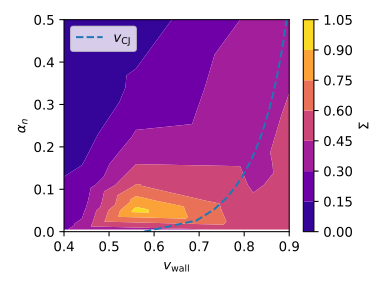
How to use PTtools
How to generate the figures on the previous slide
pip install pttools-gw
                                from pttools.analysis import plot_spectra_omgw0, plot_bubbles_v
                                from pttools.bubble import Bubble
                                from pttools.models import ConstCSModel
                                from pttools.omgw0 import Spectrum

                                alpha_n = 0.2
                                model = ConstCSModel(css2=1/3, csb2=1/4, alpha_n_min=alpha_n)
                                bubbles = [
                                    Bubble(model, v_wall=0.3, alpha_n=alpha_n),
                                    Bubble(model, v_wall=0.5, alpha_n=alpha_n),
                                    Bubble(model, v_wall=0.9, alpha_n=alpha_n)
                                ]
                                spectra = [Spectrum(bubble, r_star=0.1, Tn=200) for bubble in bubbles]

                                plot_bubbles_v(bubbles, path="bubbles.svg", v_max=0.5)
                                plot_spectra_omgw0(spectra, path="spectra.svg")

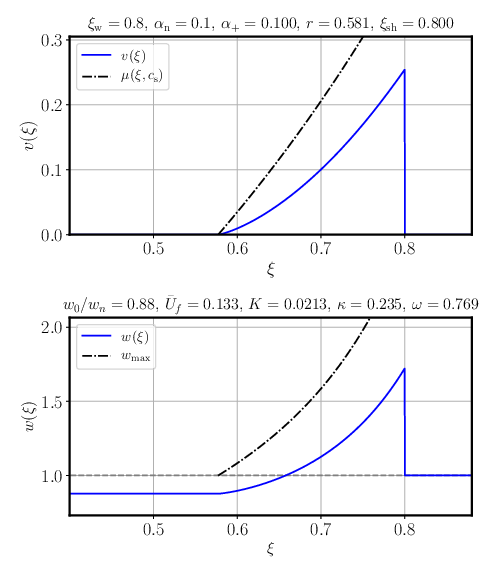
Fluid shell algorithm: detonations
-
Solve boundary conditions at the wall for known $w_+=w_n, v_+=0$
- Using user-provided $p(T,\phi)$ → numerical solving
-
Integrate from the wall to the fixed point at $v=0$
- Using $c_s^2(w,\phi)$ based on user-provided functions → numerical ODE integration
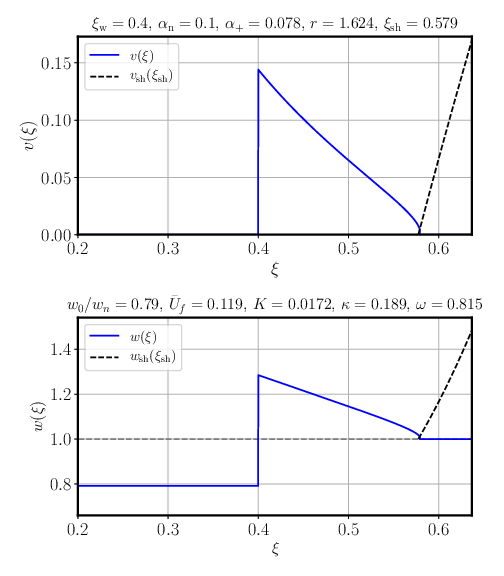
Fluid shell algorithm: deflagrations
- Guess $w_-$, the enthalpy behind the wall
- Solve boundary conditions at the wall for $w_+, v_+$
-
Integrate to the shock
- $v_{sh}(\xi)$ is computed from the boundary conditions → has to be found numerically
- Solve boundary conditions at the shock
- Check if $w=w_n$
- If not, change the enthalpy guess and try again
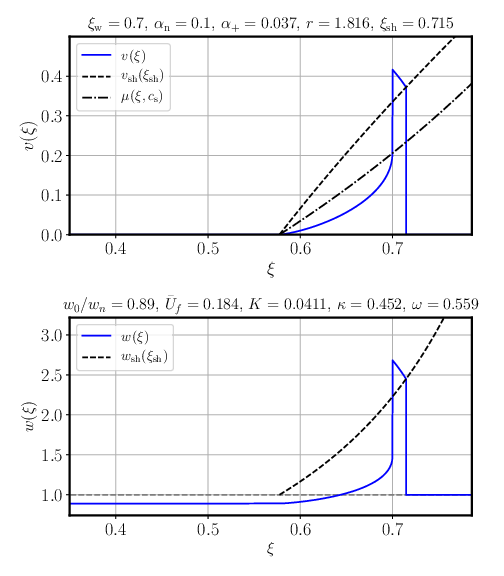
Fluid shell algorithm: hybrids
- The same as for subsonic deflagrations, but with an additional integration behind the wall
- Guess $w_-$, the enthalpy behind the wall
- Solve boundary conditions at the wall for $w_+, v_+$
- Integrate to the shock
- Solve boundary conditions at the shock
- Check if $w=w_n$
- If not, change the enthalpy guess and try again
- Once the correct enthalpy has been found, integrate from the wall to the fixed point at $v=0$
General equation of state
- Equation of state for an ultrarelativistic plasma with multiple degrees of freedom $$p(T,\phi) = \frac{\pi^2}{90} g_p(T,\phi) T^4 - V(T,\phi)$$
-
The rest can be deduced with thermodynamics
- Entropy density $s = \frac{dp}{dT}$
- Enthalpy density $w = Ts$
- Energy density $e = w - p$
- Sound speed $c_s \equiv \sqrt{\frac{dp}{de}}$
Simple equations of state
- Bag model: equation of state with constant degrees of freedom $$g_\pm = \frac{90}{\pi^2} a_\pm \quad \Rightarrow \quad p_\pm = a_\pm T^4 - V_\pm, \quad c_s^2 \equiv \frac{dp}{de} = \frac{1}{3}$$
- Constant sound speed model (aka. $\mu, \nu$ model or template model) $$\begin{align} g_{p\pm} &= \frac{90}{\pi^2} a_\pm \left( \frac{T}{T_0} \right)^{\mu_\pm - 4} \\ \Rightarrow \quad p_\pm &= a_\pm \left( \frac{T}{T_0} \right)^{\mu_\pm - 4} T^4 - V_\pm {\color{gray} \approx a_\pm T^{\mu_\pm} - V_\pm } \\ c_{s\pm}^2 &= \frac{1}{\mu_\pm - 1} \end{align}$$
Equation of state from an arbitrary particle physics model
- Non-constant degrees of freedom → varying speed of sound $c_s(T,\phi)$
- The equation of state can be constructed from $V(T,\phi), \ g_p(T,\phi)$ and preferably also $g_e(T,\phi)$ or $g_s(T,\phi)$ $$\begin{align} g_p &= 4g_s - 3g_e \\ e(T,\phi) &= \frac{\pi^2}{30} g_e(T,\phi) T^4 + V(T, \phi) \\ p(T,\phi) &= \frac{\pi^2}{90} g_p(T,\phi) T^4 - V(T, \phi) \\ s(T,\phi) &= \frac{2\pi^2}{45} g_s(T,\phi) T^3 \end{align}$$
- This can also be done with e.g. WallGo
Wave equation
- Constant background space-time → energy-momentum conservation $\nabla_\mu T^{\mu\nu} = 0$
- Energy-momentum tensor of an ideal fluid $$T^{\mu \nu}_f = (e+p) u^\mu u^\nu + p g^{\mu \nu}$$
- For a one-dimensional flow in Cartesian coordinates $$\begin{align} \partial_t \left[ (e+pv^2) \gamma^2 \right] + \partial_x \left[ (e+p) \gamma^2 v \right] &= 0, \label{eq:ep_conservation_1d_1} \\ \partial_t \left[ (e+p) \gamma^2 v \right] + \partial_x \left[ (ev^2 + p) \gamma^2 \right] &= 0 \label{eq:ep_conservation_1d_2} \end{align}$$
- First-order perturbation → wave equation with a speed of sound $$\partial_t^2 (\delta e) - \frac{\delta p}{\delta e} \partial_x^2(\delta e) = 0 \qquad c_s^2 \equiv \frac{dp}{de} = \frac{dp/dT}{de/dT}$$
Phase boundary
- Energy-momentum conservation $$\nabla_\mu T^{\mu\nu} = 0 \quad \Rightarrow \quad \partial_z T^{zz} = \partial_z T^{z0} = 0$$
- Inserting ideal fluid $T^{\mu \nu}_f = (e+p) u^\mu u^\nu + p g^{\mu \nu}$ → junction conditions $$\begin{align} w_- \tilde{\gamma}_-^2 \tilde{v}_- &= w_+ \tilde{\gamma}_+^2 \tilde{v}_+ \label{eq:junction_condition_1} \\ w_- \tilde{\gamma}_-^2 \tilde{v}_-^2 + p_- &= w_+ \tilde{\gamma}_+^2 \tilde{v}_+^2 + p_+ \label{eq:junction_condition_2} \end{align}$$
- By defining new variables $\theta = \frac{1}{4}(e-3p), \quad \textcolor{red}{\alpha_+} \equiv \frac{4}{3} \frac{\theta_+(w_+) - \theta_-(w_-)}{w_+}$ $$\begin{align} \tilde{v}_+ &= \frac{1}{2(1+\textcolor{red}{\alpha_+})}\left[ \left(\frac{1}{3\tilde{v}_-}+\tilde{v}_-\right) \pm \sqrt{\left(\frac{1}{3\tilde{v}_-} - \tilde{v}_- \right)^2 + 4\textcolor{red}{\alpha_+}^2 + \frac{8}{3} \textcolor{red}{\alpha_+}} \right], \label{eq:v_tilde_plus} \\ \tilde{v}_- &= \frac{1}{2} \left[ \left( (1+\textcolor{red}{\alpha_+})\tilde{v}_+ + \frac{1-3\textcolor{red}{\alpha_+}}{3\tilde{v}_+} \right) \pm \sqrt{\left((1+\textcolor{red}{\alpha_+})\tilde{v}_+ + \frac{1-3\textcolor{red}{\alpha_+}}{3\tilde{v}_+} \right)^2 - \frac{4}{3}} \right]. \label{eq:v_tilde_minus} \end{align}$$
Hydrodynamic equations
- Energy-momentum conservation $\nabla_\mu T^{\mu\nu} = 0$
- Projection → hydrodynamic equations away from the phase boundary $$\begin{align} 0 &= u_\mu \partial_\nu T^{\mu \nu} = -\partial_\mu (w u^\mu) + u^\mu \partial_\mu p, \\ 0 &= \bar{u}_\mu \partial_\nu T^{\mu \nu} = w \bar{u}^\nu u^\mu \partial_\mu u_\nu + \bar{u}^\mu \partial_\mu p. \end{align}$$
- Using self-similarity $\xi = \frac{r}{t}$ and parametrising $$\begin{align} \frac{d\xi}{d\tau} &= \xi \left[ (\xi - v)^2 - c_s^2 (1 - \xi v)^2 \right], \\ \frac{dv}{d\tau} &= 2 v c_s^2 (1 - v^2) (1 - \xi v), \\ \frac{dw}{d\tau} &= w \left( 1 + \frac{1}{c_s^2} \right) \gamma^2 \mu \frac{dv}{d\tau}. \end{align}$$
- Note that $c_s^2$ is computed using user-provided functions